Yarn Wall Hanging: A No-Loom Project on a Dowel
Make a dense yarn hanging with a single knot: cut equal strands, attach them to a dowel with lark's head knots, arrange color bands and trim the bottom into a V or diagonal.

Tutorial at a glance
Materials
- Wooden dowel, 12 in (30 cm)
- Yarn in 2 to 4 colors
- Sharp scissors
- Stiff cardboard for measuring
- Wide-tooth comb
- Painter's tape
A yarn wall hanging does not have to involve a loom, a needle or any weaving at all. This version is built from one knot, repeated along a wooden dowel until the strands hang in a dense curtain. Color is arranged in bands as you go, and the shape comes from a pair of scissors at the end.
It is a forgiving project. Nothing is glued, so any strand can be slid along, swapped or removed until you like what you see. The only parts that reward care are cutting the yarn to a consistent length and trimming the bottom edge.
What you need
- A wooden dowel, about 12 in (30 cm) long and roughly 1/2 in (12 mm) thick. A straight, smooth branch also works.
- Yarn in two to four colors. Medium or chunky yarn fills the dowel faster than fine yarn.
- Sharp scissors.
- A piece of stiff cardboard or a large book for measuring lengths.
- A wide-tooth comb, and painter’s tape for trimming.
Choosing colors is the main design decision. Three shades from one color family give a calm gradient, and one contrasting band adds a focal point. If you want a method for narrowing down choices, building a color palette for wall art explains how to pick a small set that works in your room.
How much yarn to cut
Each strand is folded in half over the dowel, so cut every piece to twice the finished hanging length, plus a little extra for the knot and the trim.
For a hanging about 16 in (40 cm) long at its longest point, cut strands of about 36 in (90 cm). That gives two tails of roughly 18 in (45 cm) each, with a margin for shaping the bottom.
The number of strands depends on the yarn thickness, so test instead of guessing. Tie five knots, push them together and measure how much dowel they cover. If five knots cover 1 in (2.5 cm) and you want to fill 10 in (25 cm), you need about 50 strands. Leave around 1 in (2.5 cm) of dowel bare at each end for the hanging cord.
Cut equal lengths quickly
Find a piece of cardboard or a book that is about half your strand length from top to bottom. Wrap the yarn around it lengthwise, once for every strand you need, keeping the tension gentle so the yarn does not stretch. Then cut through all the loops along one edge. Every piece comes out the same length.
Tie a lark’s head knot
The lark’s head is the only knot in the project. Rest the dowel across the backs of two chairs, or tape it to the edge of a table, so that both hands are free.
- Fold one strand in half to make a loop at the middle.
- Place the loop behind the dowel, pointing up, with the two tails hanging down in front of you.
- Fold the loop forward over the top of the dowel.
- Pull both tails through the loop.
- Tighten by pulling the tails down evenly until the knot sits snug against the dowel.
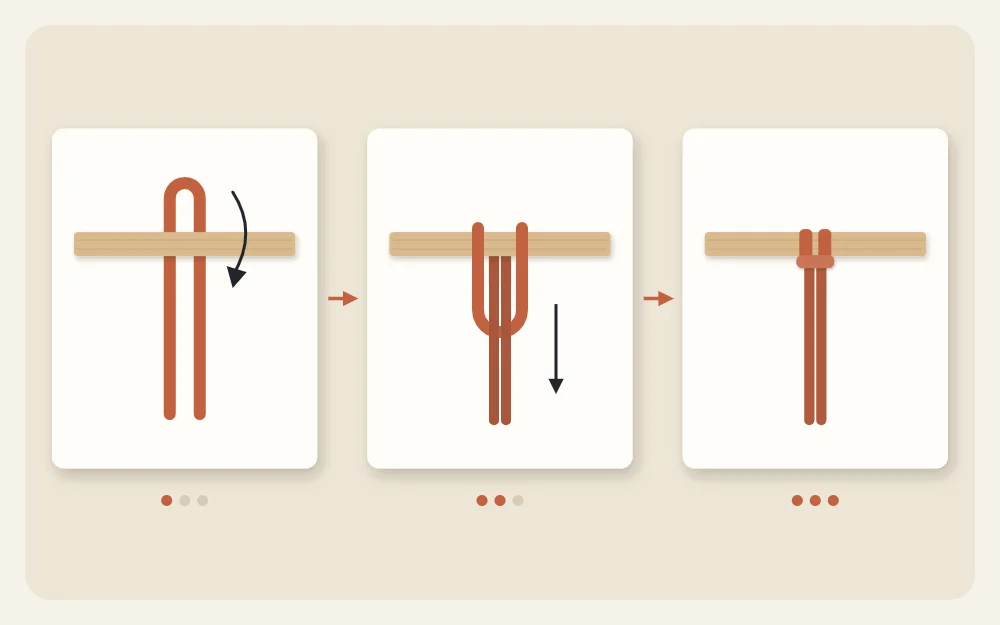
Tie every knot facing the same way so the small horizontal bar of each knot lines up along the front. For a thicker, fuller look, hold two or three strands together and tie them as one.
Arrange the color bands
Work from one end of the dowel to the other, pushing each new knot firmly against the last. Gaps between knots show as thin spots once the hanging is on the wall.
A few band layouts to try with your own colors:
- Even stripes. The same number of knots in each color, repeated.
- Graduated bands. Light to dark from left to right, with each band a little wider than the one before.
- Mirrored. One color in the center and matching bands stepping outward on both sides. This pairs well with a V trim.
- Blended edges. Where two bands meet, alternate single strands of each color for a few knots so the change is gradual.
Step back after each band. Because the knots slide, you can still widen a band or move a color before going on.
Comb out the fuzz
Once the dowel is full, hang it up or hold it at arm’s length and run your fingers down through the strands to straighten them. Many yarns hold a kink from being wound in a ball. A light mist of water and a few hours hanging usually relaxes it.
For a soft, brushed fringe, comb the bottom few inches with a wide-tooth comb, starting at the tips and working upward in short strokes. Plied yarns will separate into a fluffy edge. Combing takes off some loose fiber, so do it before the final trim, not after.
Tip
Test the comb on a spare strand first. Some yarns fluff nicely, and others just fray and thin out. If yours frays, leave the strands as they are.
Trim the bottom
The trim turns a row of knots into a finished shape. A straight edge is the simplest. A V point looks balanced and centered. A diagonal slope is more relaxed and suits graduated color bands.
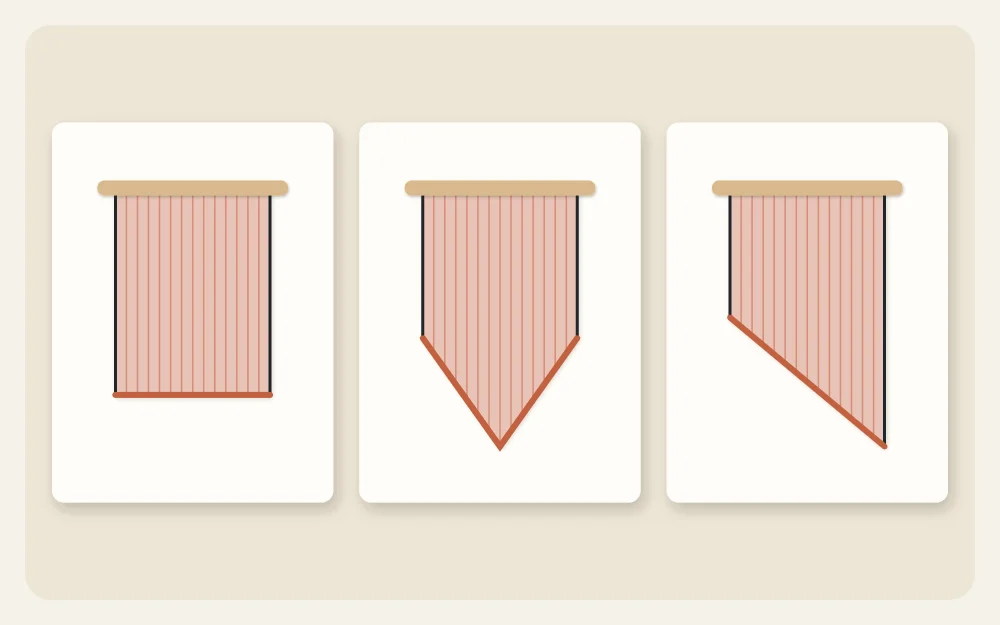
- Lay the hanging flat on a table and smooth all the strands straight down.
- Mark the cutting line with a strip of painter’s tape laid across the strands. For a V, use two strips that meet at the center.
- Check that the line is even by measuring from the dowel to the tape at both sides.
- Cut along the edge of the tape with sharp scissors, a small section at a time.
- Hang it up, let the strands settle, and snip any that still stick out.
Cut less than you think you need on the first pass. You can always trim more.
Add a hanging cord
Cut a piece of yarn or cord about twice the length of the dowel. Tie one end to each bare end of the dowel with a double knot, and trim the tails or tuck them behind the first strands. A shorter cord makes a shallow triangle above the dowel, and a longer one makes a taller peak.
A yarn hanging is usually light, but weigh the finished piece anyway, identify your wall material, and choose a hook or nail that its manufacturer rates for that weight and wall type. Follow the package instructions. How to hang lightweight wall art goes through the options, and if you rent, check with your landlord before making holes.
If you have yarn left over, the offcuts and spare lengths are ideal for yarn wrapped wall art, which uses the same colors in tight, flat bands instead of loose strands.
Frequently asked questions
What kind of yarn works best for a wall hanging?
Medium to chunky yarn covers a dowel quickly and hangs with good body. Cotton hangs straight and gives clean lines, while wool and acrylic blends look softer and comb out into a fluffier fringe. Mixing thicknesses in one piece adds texture, as long as the lengths match.
How do I get the strands to hang straight?
Yarn often keeps a wave from being wound in a ball. Hang the finished piece, mist it lightly with water, smooth the strands downward with your fingers and let it dry in place. Trim the bottom only after the strands have relaxed, or the edge will end up uneven.
How many strands do I need for a full-looking hanging?
It depends on yarn thickness, so tie five test knots, push them together and measure the width they cover. Divide the length of dowel you want to fill by that figure to estimate the total, then cut a few extra strands in each color.